

Financial markets can fluctuate for many different reasons. Are you worried how market ups and downs might affect your investments? It’s a very common concern. The good news is that we’re here to help. We’ve got five tips for keeping your emotions in check and your financial goals on track.
1. Keep calm and carry on
In investing, as in life, it’s better to avoid making snap decisions based on your emotions.
Here’s an illustration of what can happen with your investments if your let your feelings run the show.
This curve shows how the stock market moves over time, along with the typical reactions of growth stock investors* at each stage.
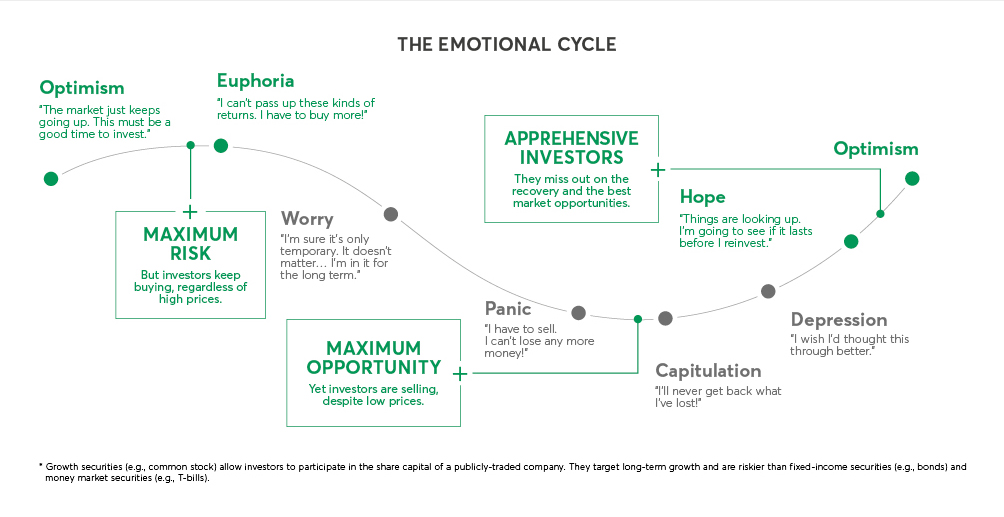
These emotions are perfectly normal, but they can cause people to make poor choices. When the stock market is on an upswing, optimism tends to soar. But then when share prices fall, worry sets in and panicked investors may rush to sell their holdings. This means they miss out on opportunities when the market picks back up again.
By keeping a cool head, you can focus on achieving your initial goals. In other words, keep calm and carry on. Don’t lose sight of what matters most: your long-term targets.
2. Markets have historically trended upwards
No one can predict exactly when a bear market will end or a bull market will begin. That was true 100 years ago, 25 years ago and 2 months ago, and it’s still true today.
But markets often rebound quickly after a sharp drop, and then continue on an upward trajectory. Past performance is no guarantee of future results, but we’ve seen this scenario play out time and time again in past decades.
3. What goes down usually comes back up
Believe it or not, markets often deliver the best returns right after huge drops (aka market corrections). Walking away from your investment strategy could hurt your long-term returns.

This table shows the negative impact of exiting the market during periods of volatility. You can see that missing out on just a few of the best trading days sharply reduces long-term returns.
That’s why staying invested can really pay off when you’re focused on the long term.
4. Automatic contributions keep your emotions in check
If you automatically invest the same amount on a regular basis, you won’t be tempted to try to “beat the market.” You’ll avoid making hasty trades when panic sets in or waiting on the sidelines for too long when markets start picking up steam.
Setting up automatic transfers can help you stay invested, no matter what’s happening in the markets.
If you can afford it, keep up or increase your automatic contributions. It can put you in a better position to take advantage of the next big opportunity.
5. Diversified portfolios are usually more resilient
Portfolios with a mix of investment types tend to hold up better during market volatility because losses in one area may be offset by stability or gains in another.
As a general rule, you’ll be less affected by sharp swings compared to investors who are concentrated in a single type of investment or a limited number of securities.
Whether you’re just starting out or getting close to retirement, remember to stick to your goals, manage your emotions and set up an automatic savings plan. That’s how you stay on track towards your financial objectives.
If you’re feeling overwhelmed, take a deep breath. The past 100 years show that changing course in a downturn might not be the wisest investment strategy. It’s probably better to wait until your emotions—and your portfolio—have stabilized.
If you’re losing sleep over market volatility, don’t keep your worries to yourself. Talk to your advisor for guidance and reassurance. We’re here to help you navigate choppy markets.