
- Sonny Scarfone
Principal Economist
Weekly Commentary
Quebec 2026: A Pivotal Moment for Demographic Policy
A sensible target for permanent immigration won’t be enough without major productivity gains
November 21, 2025
2025 has been full of twists and turns, few of which were positive. Yet in October, Quebec’s unemployment rate was lower than it was 12 months before despite the uncertainty caused by the US election results and the attendant upheaval in our main export partner’s trade policy.
While lower unemployment may initially seem encouraging, it’s part of a more complex dynamic: a demographic shift that’s putting increasing pressure on the labour market. Given the province’s demographic fundamentals (rising retirements, falling birth rates and slower growth in the working-age population), the unemployment rate will likely continue to converge towards 4% for the rest of the decade unless there’s a major recession. This may sound positive, but it doesn’t necessarily bode well for Quebec’s economic well-being. It poses big challenges for economic growth, the provincial budget and the long-term viability of public services.
Against this backdrop, on November 5, the Quebec government announced that permanent immigration targets for 2026–2029 would be set at 45,000 people per year—a level slightly below those seen in the 2010s. Although this is the most ambitious target considered, it won’t be enough to reverse the current demographic trend. Deaths now outnumber births in Quebec (graph 1). In 2024, this led natural population growth to turn negative for the first time, a stark change from the annual increase of more than 20,000 people seen ten years ago.
Meanwhile, the various levels of government want to bring the proportion of non-permanent residents (NPRs) down to 5% of the population, from just under 7% in Quebec today.
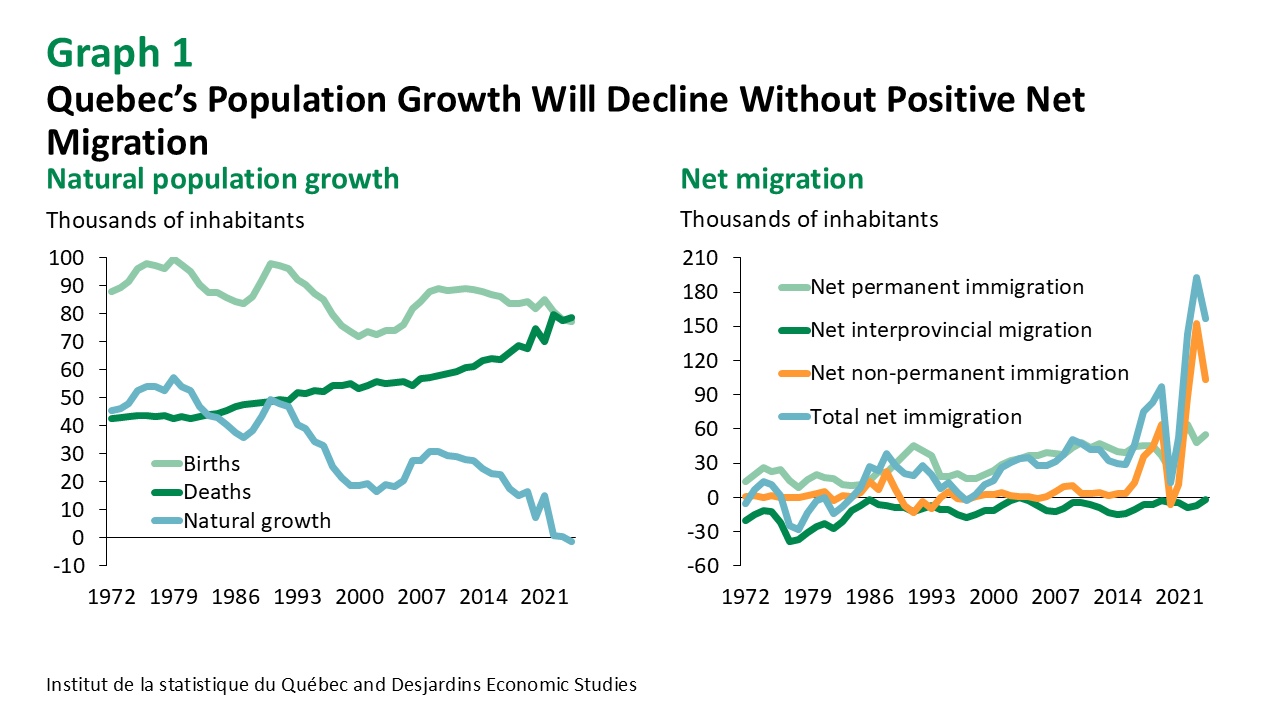
The desire to reduce immigration targets—especially for NPRs—stems from legitimate concerns: strained public services, housing pressures, rising youth unemployment and the challenges of integrating newcomers into a French-speaking society that’s a minority in North America. That said, we must consider the medium- and long-term effects of these decisions. Given Quebec’s aging population and stagnant labour force, aggressively cutting back on immigration could exacerbate labour shortages, slow down economic growth and make it harder to balance public finances. These decisions must be made transparently, with a clear understanding of the trade-offs involved.
Our Baseline Scenario
We’ve developed an analytical framework to estimate the impact of different demographic policies through 2050. It factors in a number of variables: permanent immigration targets, decisions on temporary immigration (as a percentage of the population), birth rates, labour force participation by age and gender, and projected life expectancy for different age groups.
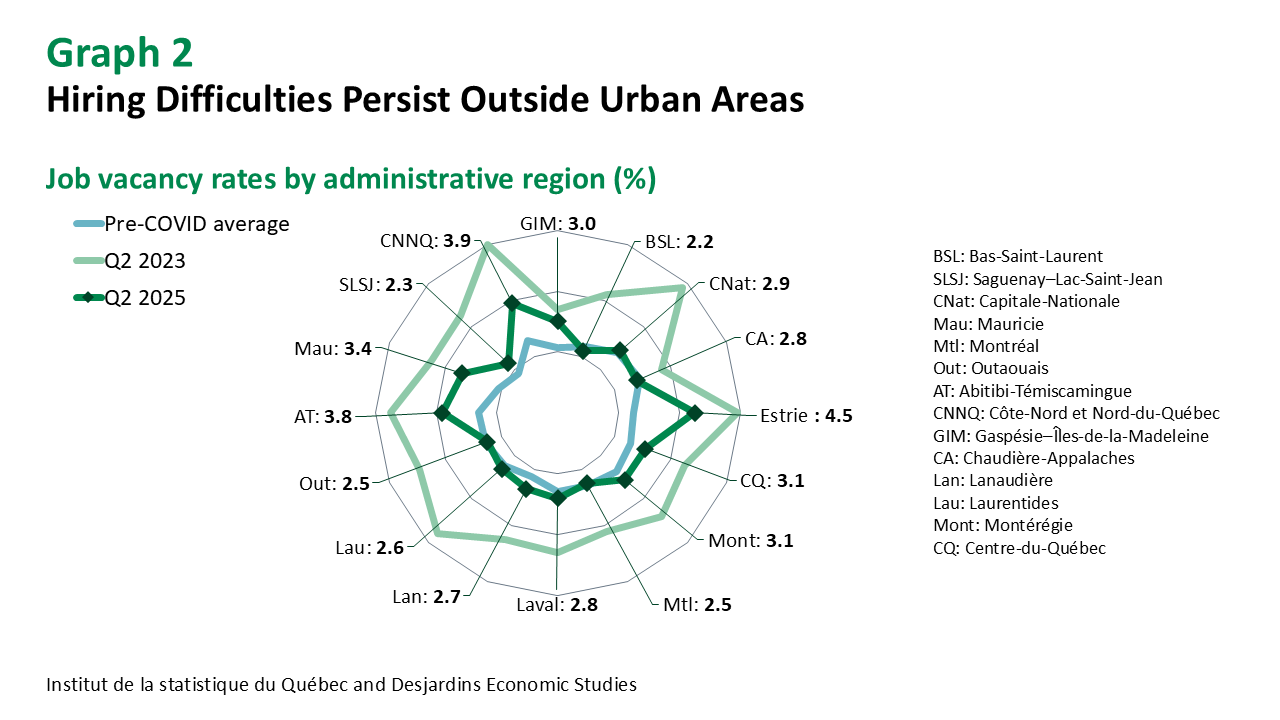
Since July, when the Institut de la statistique du Québec predicted that population growth would remain flat for the next decade, we’ve expressed our skepticism that the policy intentions used as inputs in these demographic projections would remain intact. Several factors need to be considered, including persistent hiring difficulties in non-urban areas, where job vacancy rates mostly remain above the pre-pandemic average (graph 2).
We still expect that the province won’t be able to fully meet its targets for reducing the number of NPRs over the period in question. This decrease could be mitigated by factors such as the potential introduction of exceptional measures, like a grandfather clause maintaining the eligibility of immigrants already living in the province—especially outside of urban areas. Most NPRs have already spent years trying to integrate into Quebec society and developing their skills at their workplaces, and the companies that employ them have already invested in their training. In many cases, they hold jobs that Canadian-born workers often don’t want.
We based the demographic forecasts in graphs 3 and 4 on the following assumptions:
- The permanent immigration targets announced for 2026 to 2029 will be met.
- After that, permanent immigration levels will return to the 2000–2019 average, or approximately 0.6% of the population. This amounts to about 55,000 to 60,000 permanent immigrants per year between 2031 and 2050.
- NPR reduction targets will be partially achieved, though this will happen over a longer period, with a target of 5% of the total population maintained over the long term.
- The birth rate remains stable.
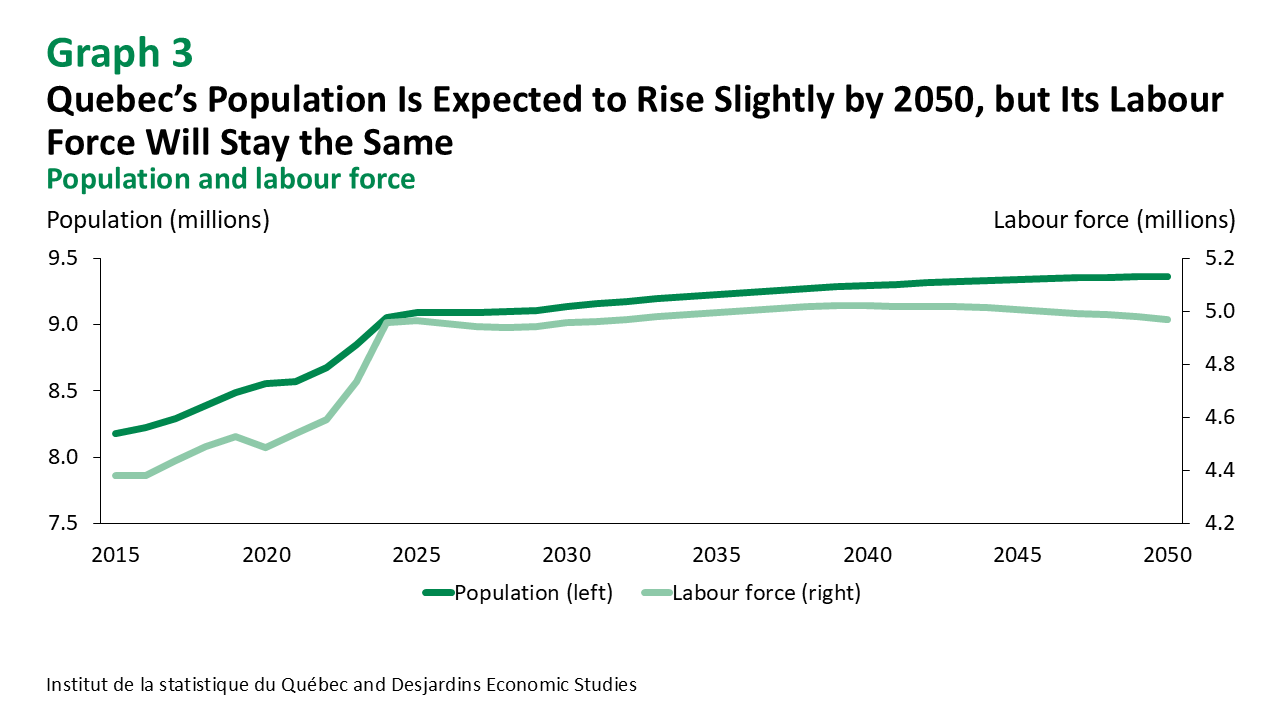
Graph 3 shows the population stagnating through 2030, followed by a gradual return to growth. But this recovery remains limited: The population is projected to grow by only 275,000 between 2025 and 2050, about half the absolute growth seen since 2022. In contrast, the working-age population would hold steady at its current level over the coming decades.
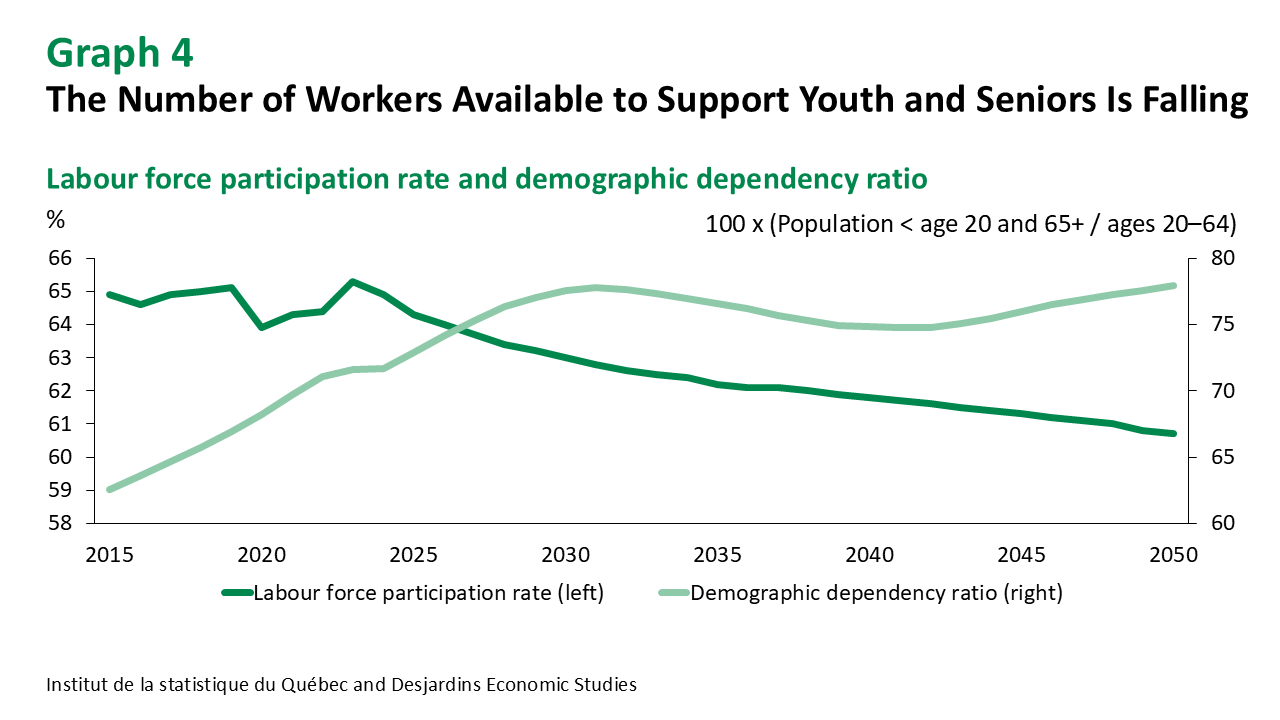
Graph 4 illustrates the impacts of an aging population on the labour force participation rate and dependency ratio. The labour force participation rate would gradually fall to about 60%, which is where it was in the late 1970s. Back then, women started entering the workforce in large numbers, a trend that accelerated in the 1990s when Quebec introduced subsidized daycare. Today, Quebec has one of the highest female labour force participation rates in the world.
At the same time, the dependency ratio would hit a peak of about 80. This means that there would be around 80 people of school or retirement age for every 100 people of working age. The last time this ratio was that high, the baby boomers were still in school. This time, however, the demographic pressure will come mainly from an aging population whose healthcare needs far exceed the costs associated with educating young people in primary and secondary school.
This trend will have major implications for Quebec’s public finances. With a stagnant working-age population and a declining labour force participation rate, the tax burden on workers will likely increase, while tax revenue growth will lag behind spending. Unless there are some major changes—to productivity growth, fiscal policy or public services—the current fiscal template may become hard to sustain over the medium and long term.
Spotlight on 2026: A Collective Decision That Must Be Fully Embraced
Obviously, a number of variables could lead to different demographic trajectories. In a forthcoming analysis, we’ll examine various scenarios while taking a closer look at the challenges posed by the falling birth rate, which hit a new low of 1.34 children per woman in Quebec in 2024. Although increasing the birth rate could support natural population growth, it would also raise the dependency ratio until newborns reach working age, which means the demographic benefits won’t be felt for decades.
Ultimately, as the French philosopher Auguste Comte once said, demography is destiny. Allowing the labour force participation rate and the pool of workers supporting youth and seniors to shrink is a societal choice that may be justified by non-economic factors. Our baseline scenario sees the working-age population staying about the same size, but assumes that permanent immigration targets will return to pre-pandemic levels. But if the government maintains the target of 45,000 after 2030, the labour pool will start to contract immediately, with the decline picking up speed in the late 2030s.
Conversely, it would also be a reasonable societal choice to keep immigration levels high, with all the challenges this would entail in terms of promoting the use of French, integrating newcomers and dealing with increased pressure on public services. What matters most is transparency about the trade-offs that must be made, regardless of the path chosen. As Quebec heads into an election year, it would be wise for the various parties to fully address the issues surrounding their proposals without glossing over the compromises they entail.
Under these circumstances, the new target of 45,000 permanent immigrants per year seems fairly balanced. It partly meets labour market needs while also considering the strains placed on the province’s capacity for settling and integrating newcomers in recent years. However, without the significant productivity gains that are needed—something we haven’t seen in a long time—maintaining this level beyond the next few years could dampen Quebec’s appeal to investors and limit its potential for medium- and long-term economic growth. We’ll discuss this topic in more detail in our upcoming report.
Meanwhile, the budget pressures stemming from an aging population cannot be ignored. The cost of health care for seniors will grow faster than the tax revenues collected from a stagnant working-age population. Without structural reforms—to modernize public services, review fiscal policies or reach a consensus External link. that will break down barriers to wealth creation and boost productivity—the sustainability of Quebec’s fiscal framework could be jeopardized.